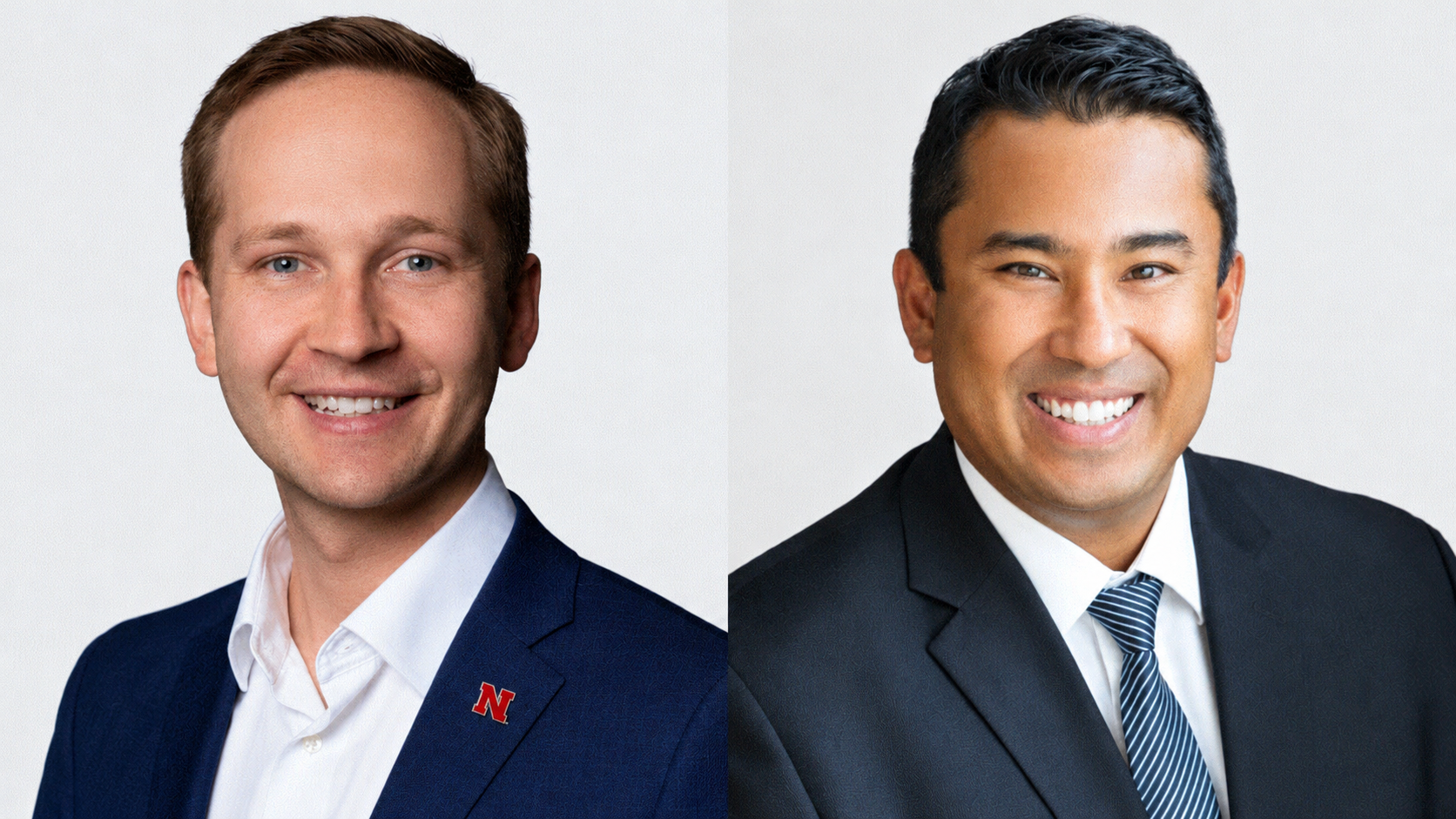
Growing enrollment, preparing students for artificial intelligence and defining the role of university leadership are among the priorities Brent Comstock and Dr. Jeremy Hosein are outlining as they compete for the University of Nebraska Board of Regents.
The candidates are seeking the District 1 seat, which covers northeast Lancaster County, including much of Lincoln. The winner of the November 3 election will replace retiring Regent Tim Clare, who is not seeking another term.
Comstock is the founder and CEO of Lincoln advertising and marketing firm BCom. Hosein is a Lincoln neurosurgeon and former University of Nebraska Medical Center student regent. The race is officially nonpartisan; Comstock is a registered nonpartisan, while Hosein is a registered Republican.
The board governs the entire University of Nebraska system, with responsibilities that include approving budgets and tuition rates and selecting the university president. Elected regents serve 6-year terms.
Both candidates discussed their approaches in separate KLIN interviews, including how the university can attract more students while navigating financial challenges.
Comstock said enrollment growth should be central to addressing budget pressures, alongside opportunities to streamline operations. “You know, you can’t cut your way to success,” he said.
His approach includes retaining Nebraska students, recruiting more out-of-state and international students and helping students build connections with employers and their communities. “And embed them into the community, because if people have more than just a college degree from here and they have relationships and they have opportunities here, guess what? They’re going to stay,” Comstock said.
Hosein said recruitment must also reach beyond students entering college directly from high school. He identified working parents, military veterans and people seeking career advancement as potential students the university should do more to accommodate. “And this is where we create those partnerships with employers, not just here, but nationwide, uh, to grow enrollment,” Hosein said. He also supports more flexible scheduling, lower-cost online courses and evaluating professional credentials and community college coursework for academic credit.
Artificial intelligence presents another challenge for the university as employers increasingly expect graduates to understand the technology. Both candidates emphasized maintaining a human role in its use and involving faculty in academic decisions.
Hosein said safeguards should guide the adoption of AI. “And so, you know, guardrails are important and I’ve always maintained that we should have a people first philosophy when it comes to implementation of this technology,” he said.
Drawing on his experience in medicine, Hosein described using technology to assist with documentation while allowing him to focus on patients. He said human judgment and interaction remain important even as technology becomes more capable.
Comstock said faculty should help establish guidelines that allow AI to support teaching and innovation. “Think of how much we can grow and scale as well by leveraging that tool in the right way,” he said.
He said those guidelines should provide a foundation for pursuing new opportunities in fields such as agriculture, biofuels, finance and insurance. His approach emphasizes the continued importance of the people who teach and conduct research.
The candidates also described limits on how regents should involve themselves in campus operations. Comstock said board members should establish direction while allowing university employees to carry out their responsibilities. “It’s a governance board. It’s not a management board,” Comstock said. He also expressed support for academic freedom and faculty authority over classroom instruction.
Hosein similarly said regents should focus on the university’s long-term direction rather than micromanaging campuses. He pointed to the faculty senate as an important participant in academic decisions. “I believe that they should have an important role in all academic matters of the university,” Hosein said.